Losing a tooth is something many adults and seniors experience at some point. Whether it is a fractured tooth, an unavoidable extraction or a tooth that has been missing for years, the same question often comes up: what are the options for replacing this tooth? Among the available solutions, the dental implant plays an important role. This article explains clearly, without unnecessary jargon, what an implant is, how treatment generally works and in which situations it may be considered.
An examination by a dentist is still essential to determine whether an implant is right for your personal situation.
What is a dental implant?
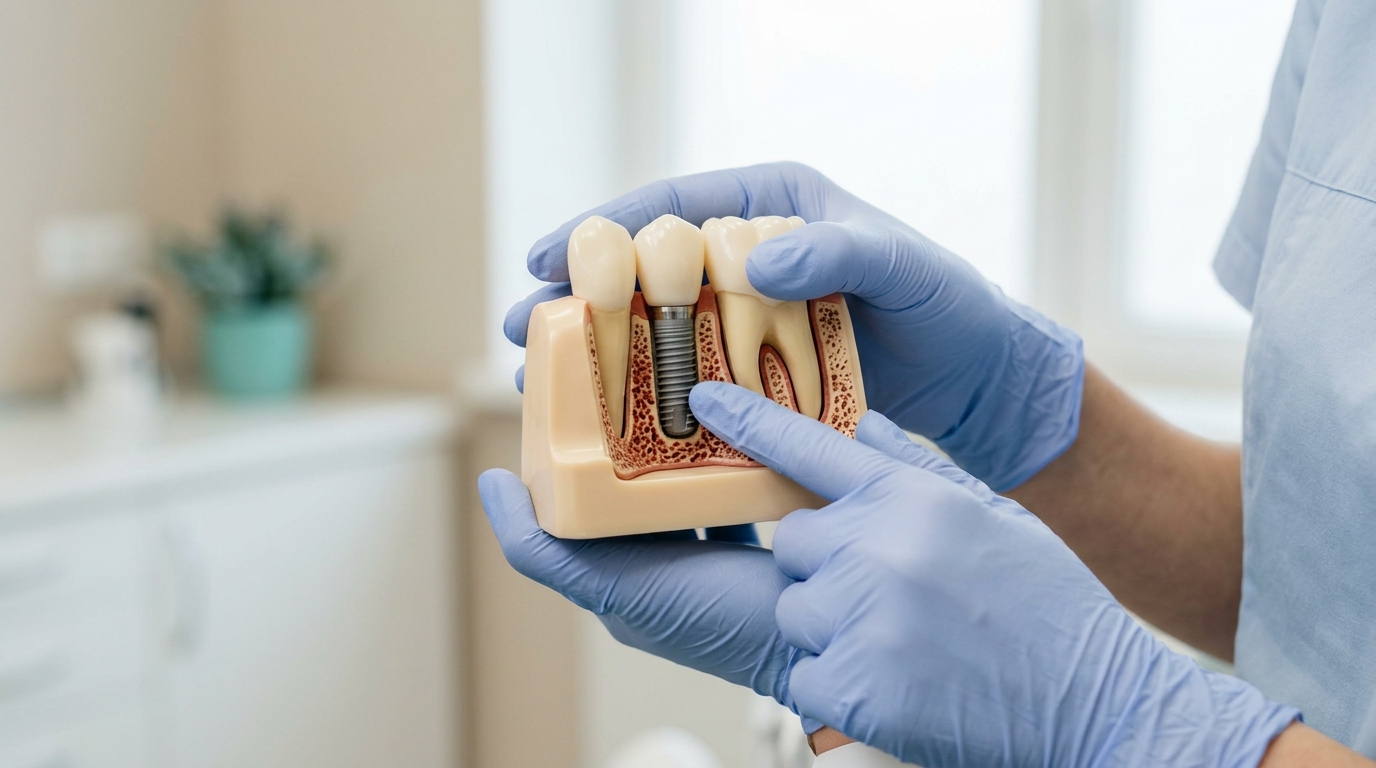
A dental implant is a small titanium screw placed in the jawbone, where the root of the missing tooth used to be. Once the implant has fused with the bone (a process called osseointegration), it supports a crown, a bridge or a removable denture.
In other words, the implant replaces the root of the tooth. This is what sets it apart from a conventional removable denture, which rests on the gums, or a conventional bridge, which relies on the neighboring teeth. The implant is anchored in the bone, which gives it particular stability.
The main stages of treatment
Every treatment path is different, depending on each patient’s situation. Nevertheless, these are the stages generally found in implant treatment.
1. The initial assessment
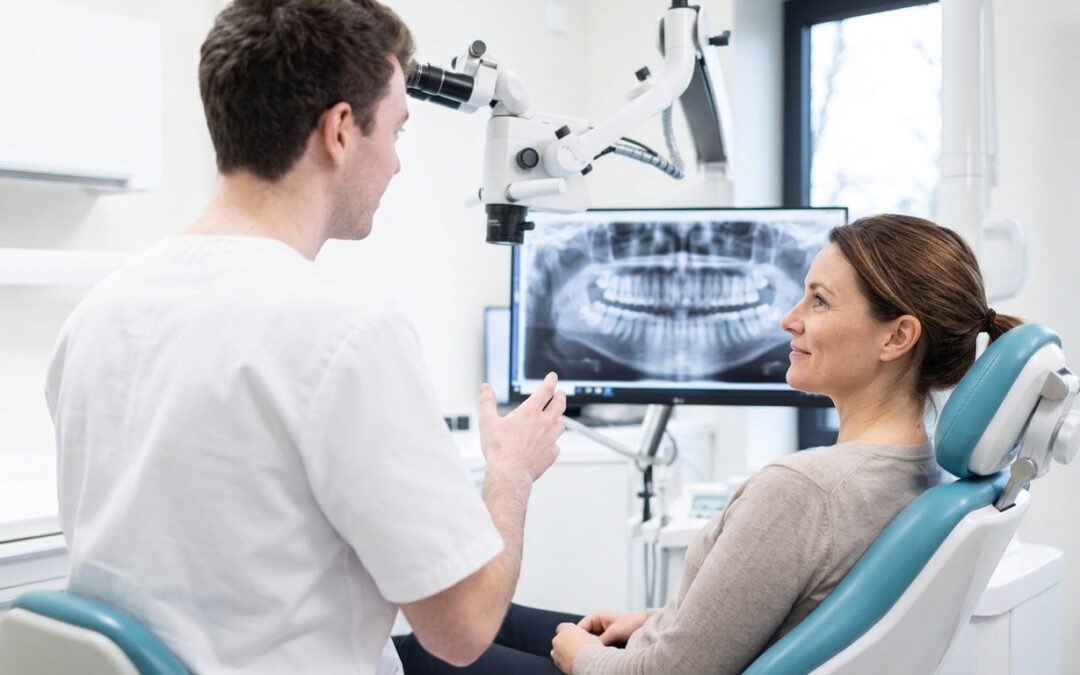
Before any decision is made, a thorough assessment is needed. At Clinique Keller, this step includes a full clinical examination and X-rays taken on site: intraoral X-ray, panoramic X-ray or CT scan (also called cone beam), depending on what your situation requires. These examinations allow us to analyze the quantity and quality of the available bone, as well as its relationship to the surrounding anatomical structures.
At this stage, the team also assesses your general health, the condition of your gums and your habits (such as smoking, which can affect healing). Gum treatment is sometimes recommended before an implant is placed. To learn more about gum health, see our periodontology page.
2. Placing the implant
Implant placement is a surgical procedure performed at the clinic. The implant, a titanium screw, is inserted into the jawbone. A healing period follows, during which the bone gradually fuses with the implant. This period varies from patient to patient and from one clinical situation to another.
3. Fitting the crown or denture
Once osseointegration is confirmed, an intermediate component (called an abutment) is attached to the implant. It connects the implant to the final restoration, which may be a crown, a bridge or a retention element for a removable denture.
4. Follow-up
Regular check-ups are scheduled after placement. Rigorous oral hygiene is essential to preserve the implant over the long term. Our hygienist can help you with this maintenance, notably with the GBT method (Guided Biofilm Therapy), which is also suitable for patients with implants.
When can an implant be considered?
Implantology covers many situations. Here are the three main indications offered at Clinique Keller.
Single implant: replacing one tooth
This is the most common indication. When a single tooth is missing, one implant can be placed in that exact spot, and a crown is then attached to it. The main advantage: the neighboring teeth are left untouched, unlike a conventional bridge, which requires the adjacent teeth to be filed down so they can serve as supports.
Implant-supported bridge: replacing several teeth
When several teeth are missing in the same area, it is not always necessary to place one implant per missing tooth. Two or more implants can be enough to support a fixed bridge, in other words a prosthesis that does not come out. This solution gives a stable, functional result for chewing and speaking normally.
Stabilizing a removable denture: regaining stability
Some people have worn a complete removable denture for a long time and struggle with its lack of stability, especially in the lower jaw. Two to four implants can be placed to anchor the denture. It clips onto them and can still be removed, but it is far more comfortable to wear every day. This option is particularly appreciated by seniors who do not want, or are not able, to consider a more extensive reconstruction.
Who can benefit from a dental implant?
There is no upper age limit for receiving an implant. However, implants are generally not recommended before bone growth is complete, that is, before roughly seventeen or eighteen years of age. Implants are therefore mainly intended for adults and seniors.
Several factors affect whether an implant is feasible:
- The quantity and quality of the bone where the tooth is missing.
- The condition of the gums: untreated periodontitis must be addressed before any implant is placed.
- General health: certain conditions or medications can affect bone healing and will be reviewed during the initial assessment.
- Lifestyle: smoking in particular can affect how well the implant integrates.
Only a full clinical and X-ray examination can answer the question: “Am I a good candidate for an implant?” That is precisely the purpose of the initial assessment at the clinic.
What about day-to-day care?
An implant cannot get a cavity, since it is not made of organic material. But it is not immune to complications if hygiene is neglected. Bacteria can build up around the implant and cause peri-implantitis, an inflammation of the surrounding tissues similar to periodontitis around a natural tooth.
Careful brushing twice a day, using floss or an interdental brush, and regular visits to the hygienist are the cornerstones of effective care. The Clinique Keller team will show you the right habits for your situation.
Do you live in Woluwe-Saint-Lambert or the east of Brussels?
Clinique Keller, located at Avenue de Broqueville 249 in Woluwe-Saint-Lambert, welcomes patients from Woluwe-Saint-Lambert, Woluwe-Saint-Pierre, Kraainem, Etterbeek, Schaerbeek, Evere and the whole east of Brussels. Our multidisciplinary team brings together under one roof the expertise needed to support you at every stage of your implant treatment: full X-ray assessment on site, gum treatment if needed, implant placement and follow-up by our hygienist.
To learn more about all the treatments we offer, see our implantology page.
Book an appointment at Clinique Keller
Would you like to know whether a dental implant is an option in your situation? The first step is simple: book an assessment. You can book online directly on our website or call us at +32 2 772 10 15, Monday to Friday from 9 am to 6 pm. The clinic is easy to reach by metro: line 1, Gribaumont station.