


General dentistry
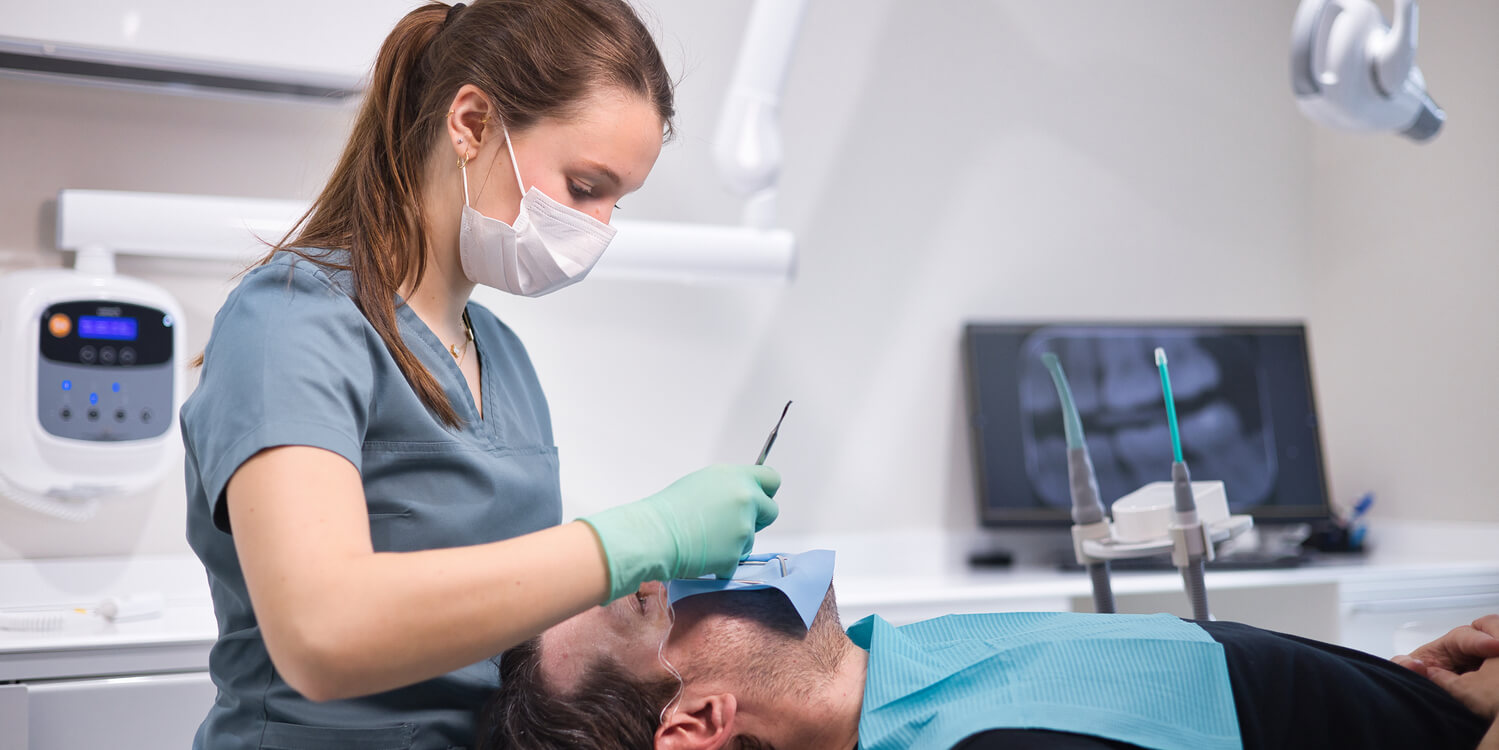
Comprehensive dental care to preserve your oral health.
General dentistry
Types of routine care
General dentistry is the foundation of good oral health. It encompasses all routine care – prevention, diagnosis and treatment – provided by our general practitioners, who are with you every step of the way, from initial consultation to long-term follow-up.
Consultation and dental check-up
The consultation is the starting point for all treatment. During this appointment, your dentist performs a complete examination of your teeth, gums and oral tissues. This check-up enables us to identify the care you need, draw up a personalized treatment plan and set up a follow-up program tailored to your situation. Afterwards, an annual check-up is recommended to prevent and detect any problems before they become more serious.
Descaling and hygiene tips
Tartar is a calcified deposit that builds up on teeth and under gums, even with regular brushing. Scaling removes it and helps prevent cavities, gingivitis and periodontal disease. At the end of the treatment, your practitioner will give you personalized oral hygiene advice.
Preventive and conservative care
The aim of conservative treatment is to preserve natural teeth as much as possible. This includes treating cavities, replacing old, defective restorations and, in the case of younger teeth, sealing fissures. Early treatment is simpler, less invasive and more durable.
Fixed prosthetics (crown, bridge, inlay/onlay, veneer, implant)
When a tooth’s structure is too altered to allow lasting conventional restoration, a fixed prosthesis may be indicated to ensure its reconstruction and protection. Depending on the clinical situation, this may be a crown, inlay or onlay, restoring function and strength to the weakened tooth while preserving its aesthetic appeal.
If one or more teeth are missing, various prosthetic solutions can be proposed, such as a fixed bridge or dental implants, to restore masticatory function, oral balance and smile harmony.
All these restorations are custom-made, with particular attention paid to aesthetic and functional integration, for a natural, long-lasting result.
Partial or complete removable prosthesis
When a tooth’s structure is too altered to allow lasting conventional restoration, a fixed prosthesis may be indicated to ensure its reconstruction and protection. Depending on the clinical situation, this may be a crown, inlay or onlay, restoring function and strength to the weakened tooth while preserving its aesthetic appeal.
If one or more teeth are missing, various prosthetic solutions can be proposed, such as a fixed bridge or dental implants, to restore masticatory function, oral balance and smile harmony.
All these restorations are custom-made, with particular attention paid to aesthetic and functional integration, for a natural, long-lasting result.
Radiological assessment (intraoral X-ray, panoramic, CT scan)
Radiology is an essential part of oral medicine diagnostics, enabling the detection of anomalies not visible during clinical examination, such as carious lesions, infections, the state of bone structures, or impacted and erupting teeth.
Panoramic radiography provides a global view of the entire dentition, maxilla and surrounding structures, facilitating an overall assessment of oral health. For situations requiring a more in-depth analysis, such as implantology, oral surgery or complex treatment planning, three-dimensional imaging by volume scanner (CBCT/CT-scan 3D) enables a precise and detailed study of anatomical structures.
The clinic boasts state-of-the-art equipment, essential for reliable diagnosis and appropriate, safe care.
Making an appointment
Book an appointment online, fast
24-hour availability to choose your specialist and time slot with ease.
Other Clinique Keller specialties
FAQ
Frequently asked questions about general dentistry
Oral health depends on regular visits and precise treatment. The Keller dental clinic in Brussels offers a full range of dental treatments, with particular attention paid to the natural preservation of your teeth.
How do I know if I need conservative treatment or a crown?
Your dentist will determine this during a clinical and radiological check-up. As a general rule, a filling is sufficient when decay is limited. A crown becomes necessary when the tooth is too fragile to be simply restored - particularly after a root canal or major fracture.
How often should I consult a doctor, even if I'm not in pain?
Annual check-ups are recommended for most patients. Certain situations - ongoing treatment, fragile periodontal terrain, wearing a prosthesis - may warrant closer monitoring. Your practitioner will be able to advise you on the most appropriate schedule for your situation.
Is scaling really necessary if I brush my teeth well?
Yes. Even with rigorous brushing, some areas remain inaccessible to the brush, and the tartar that forms there can only be removed by a professional. Regular scaling prevents gingivitis and periodontal disease.
What is an inlay/onlay and how is it different from a filling?
An inlay or onlay is a laboratory-crafted restoration made of ceramic or composite resin. Unlike direct fillings, they offer greater strength and a more precise fit, especially for posterior teeth that are subject to heavy chewing forces.
I'm afraid of the dentist... How does the first consultation go?
The first consultation is first and foremost a discussion. No treatment is carried out without your agreement. Your practitioner takes the time to explain what he or she observes, answer your questions and define treatment priorities together.
Are X-rays systematically taken at every visit?
No. A full radiological check-up (panoramic) is usually carried out at the first consultation, and then repeated as your situation evolves. Targeted x-rays may be taken occasionally in the event of symptoms or before a specific treatment.